By Carolyn Griffin
During the past few decades, golf has gained in popularity as a recreational pastime and as a passion. Golf courses comprise a variety of habitats. All areas of the golf course are a habitat—even tees, greens and fairways. When pest birds, such as geese, inhabit golf course properties, many golf course facilities make the mistake that non-intervention is the best option; however, intervention and management is the preferred bird control method. Over the past ten years, one of the main challenges for golf course owners is being environmentally sensitive.
The geese population has increased in urban and suburban areas in recent years, and they are often considered pests. Geese feed by grazing in fields and large lawns, and they are often seen in flight moving in pairs or in flocks, often in a “V” formation. Their habitat is found anywhere near lakes, rivers, ponds, or other small or large bodies of water, such as those found in golf course communities.
With a life expectancy of 25 years, geese spend most of the day foraging for food, which is primarily obtained by grazing. They like short grasslands next to a body of water and prefer fertilized grass for feeding. This is what attracts them to golf courses, playgrounds, and other well-maintained lawns.
Goose control products that will deter geese from inhabiting golf courses and other grassy areas include goose repellents and super sonics.
The goose repellent is applied to grass areas where geese have become a nuisance. You can treat grass areas where geese graze. Geese cannot stand the ingredient (grape extract, methyl anthrantitate), yet the product is safe for pets and humans. The extract irritates the goose’s trigeminal nerve and mucous membrane when a goose eats the product. Because geese do not like this sensation, they will leave the treated area.
The repellent is beneficial as it keeps property clear of pest geese and their droppings. This low cost, effective, and successful goose control solution works when geese eat the distasteful treated grass, thus impelling them to leave the area. The goose repellent is simple, easy to apply, and rain and water resistant. Finally, the product is safe and non-toxic: it will not harm humans, ducks, geese, or other animals.
The goose sonic scares pest geese with loud sounds such as distress and predator calls. The bird sonic is species specific as it allows you to choose the pest bird you are trying to eradicate. With a controllable volume, this product covers between one-six acres, is sun and weather resistant, and works day or night. You simply program the unit for your pest bird. The specific goose sonic keeps pest geese off your property, and it comes with two free satellite speakers. Finally, the cost effective and affordable goose control sonic is the lowest cost sonic system on the market.
The goose repellent and the goose sonic are two humane and simple methods to keep your golf course free of nuisance geese and their droppings. The benefits are two-fold: you can make your golf customers happy as they can play on a sanitary course which means greater profits for you as you will increase your profits from repeat customers. Thus, "Golfing Without Geese" by using goose control products translates into satisfied customers.
by Carolyn Griffin
During spring, the transition between winter and summer, a period of renewal, rebirth, and regrowth occurs. Certain signs indicate spring's arrival, such as plants blossoming and animals becoming active again. In particular, birds emerge, and many seasonal hassles result.
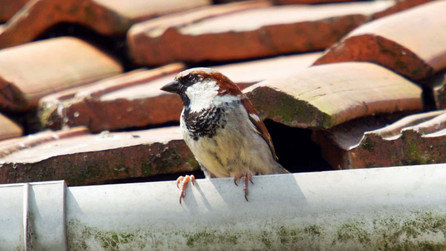
The House Sparrow, the most widely distributed wild bird in the world, is strongly associated with human habitation and cultivation. The bird is an exotic species, introduced to North America in the mid-19th century. The sparrow has had an early adaptation to living with humans and close to homes, hence the name “House” Sparrow. This bird lives near human habitation or areas with reliable food sources. For example, if you visit any mall in America, you will likely view the House Sparrow’s nests in the signage of storefronts, in street fixtures, or under a roof of eaves and awnings.
Imagine a serene, sunny day on the sparkling, cobalt blue-azure ocean—a day of boating, cruising, entertaining, or recreationally fishing. This idyllic vision is common for marine enthusiasts, who have a strong connection with the water. In 2009, The Recreational Boating and Fishing Foundation reported that greater than 60% of boating participants went cruising, followed by fishing as the second most popular boating activity. Moreover, greater than 7% of all Americans over age 16—which translates to approximately 20.5 million people—own a boat while an additional 9.6 million people are considering owning a boat.
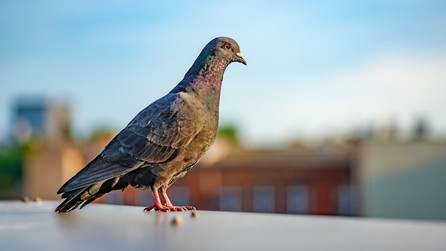
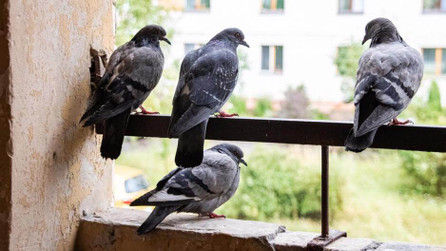
Pigeons were in the news recently for their excessive defecation on “The Kings of Leon” band at a Missouri concert venue. After an assault of pest bird poop from the stage rafters, the pigeons’ droppings shut down the concert as band members were bombarded and left the stage seeking refuge. As demonstrated here, pigeons are a health hazard and nuisance, even to unsuspecting musicians.
Your home is a sanctuary, a retreat from a busy lifestyle and a place to rejuvenate. However, peace and tranquility is not always the case. Your property may attract any of a multitude of birds, and these birds will wreak havoc on your structure if they are left unchecked. However, bird deterrent products will
With summer’s arrival, many people envision themselves sitting in their garden, enjoying the idyllic atmosphere. Gardens can have aesthetic, functional, and recreational uses. Although some gardens are for ornamental purposes only, other gardens produce food crops with decorative plants interspersed. Food gardening is on the rise. Gardens are claiming an even more important role in the gardener’s lives. According to the National Gardening Association, in 2009 43 million households grew their own fruits, vegetables, berries and herbs—that is up 19% from 36 million households in 2008.
From childish games such as Duck-Duck-Goose to Mother Goose nursery rhymes, geese can be portrayed as “silly” animals and are known for their innocence and ill fated nature. However, geese pose a real problem when they inhabit humans’ environment, and the geese population is increasing in numbers rapidly. The reasons for the increased goose population is that their habitat is abundant, they have a high reproductive potential and a long life span, and mortality from hunting and other predation is low. Furthermore, Canada geese are protected by the Migratory Bird Treaty Act, so it is illegal to hunt, kill, sell, purchase, or possess migratory birds or their parts except as regulations permit.